My cell phone was stolen today. I was waiting in the center of the village for a bus to arrive so I could send a package on it the following day. When the bus arrived, I left my bag and cell phone where I had been sitting, walked about 20 meters to speak with the driver, and returned a minute later. The phone was gone.
I don't think what happened today is any more or less likely to occur in America. Mobile phones valuable and easily concealed and are stolen all the time. Nonetheless, it never feels great to be the victim of a crime. And I was doing so well on budgeting my Peace Corps allowance this month, too.
I do take some solace in the fact that it could have been much worse - my phone was purchased used and is the cheapest model one can have in Moldova. I'll post again when I get a new phone in few days. In the mean time, feel free to call my old number - posted to the right - at all hours of the day and night. Just because the thief has my phone doesn't mean he gets to enjoy it.
Saturday, September 30, 2006

Lost in Translation
Another PCV recently posted a string of funny conversations he had at site. I thought it was a good idea, so here's one of my own...
First a little background: In Moldova, when someone comes to your house, they wait outside the gate and yell your name. Because you might be deep in the backyard garden, watching the TV extremely loudly, working in another part of the house, or just plain hard of hearing, the "caller" usually stays at the gate for several minutes, yelling the "callee's" name and making high-pitched whistling. [It really makes me think that a doorbell or some sort of "I'm home / I'm not home" sign business would do very well in Moldova. I've now actually made such a sign for my brother.]
At my house, people are usually looking for my host-bother, and even when they're looking for me they sometimes call out his name. If I'm home alone and someone comes a calling, I usually don't answer because I don't want to interrupt what I'm doing to have conversations like the one I had today. But sometimes the screaming and whistling at the gate demands attention:
Caller: Vitalik!
Caller: [20 seconds later] VITALIK! followed by high-pitched whistling. [repeat every 20 seconds for next 5 minutes]
Me: [deciding to stop the insanity, leave my room and yell back from the house door] Vitalik's not here.
Caller: Vitalik?
Me: No, Vitalik's not here.
Caller: Come here.
Me: But Vitalik's not here.
Caller: Come here, I have a question.
Me: [walk to the gate] Vitalik's not here, it's only me.
Caller: Where's Vitalik?
Me: I don't know.
Caller: Is he here?
First a little background: In Moldova, when someone comes to your house, they wait outside the gate and yell your name. Because you might be deep in the backyard garden, watching the TV extremely loudly, working in another part of the house, or just plain hard of hearing, the "caller" usually stays at the gate for several minutes, yelling the "callee's" name and making high-pitched whistling. [It really makes me think that a doorbell or some sort of "I'm home / I'm not home" sign business would do very well in Moldova. I've now actually made such a sign for my brother.]
At my house, people are usually looking for my host-bother, and even when they're looking for me they sometimes call out his name. If I'm home alone and someone comes a calling, I usually don't answer because I don't want to interrupt what I'm doing to have conversations like the one I had today. But sometimes the screaming and whistling at the gate demands attention:
Caller: Vitalik!
Caller: [20 seconds later] VITALIK! followed by high-pitched whistling. [repeat every 20 seconds for next 5 minutes]
Me: [deciding to stop the insanity, leave my room and yell back from the house door] Vitalik's not here.
Caller: Vitalik?
Me: No, Vitalik's not here.
Caller: Come here.
Me: But Vitalik's not here.
Caller: Come here, I have a question.
Me: [walk to the gate] Vitalik's not here, it's only me.
Caller: Where's Vitalik?
Me: I don't know.
Caller: Is he here?
It Never Rains, but it Pourshttp://www.blogger.com/img/gl.link.gif

The wine season is upon us. Moldovans are picking their grapes and turning them into home wine. In the fields of the kalhouz, school children from the 8th grade and up get out of school for two weeks to go pick grapes. The kids have mixed feelings about this: on the one hand they get out of school and earn about 50 lei ($5) a day, which is usually handed over to the family's budget; on the other hand these are longer, more physical days than they have in class.
I'm pretty certain that this is required work. If you're not going to participate, you must have a doctor's note to say you're sick. I know several people who have scheduled doctor's visits or operations during this time. Perhaps a coincidence, perhaps not.
I'm reminded of the cotton production of Uzbekistan, which "required" school children to help harvest the nation's cash crop. Unfortunately, I wasn't there during the fall and late summer to be able to fully understand the process.
To better appreciate the process in Moldova, I decided to work a day in the fields. The kids meet at 8am at school. Everyone brings a bucket, clippers, and lunch. A bus takes different classes to different fields. In pairs, students walk down the rows of grapes filling their buckets. When done, they dump the grapes into a large trailer at the end of the rows. Their homeroom teacher stands by the trailer and records how many buckets each student picked.
I had only been there for a little while - enough to pick 2 buckets - when the skies opened up and the rain came down. At first we worked through it, but when it didn't stop we decided to call it a day.
About that time, Oleg called and said he needed my help for a road project some villagers wanted to submit to IREX. I got a ride home, quickly changed out of my soaking clothes, and headed into the office.
While helping with the grant application, two people from LGRP showed up to install 1C (link in Russian or English), an all-encompassing municipal accounting program, on our computers. So I began helping with that too.
All in all, a good productive day that definitely didn't follow the plan.
Monday, September 25, 2006
Tractors
After dinner tonight, my host-brother asked if I'd help him outside for a moment. Always up for an adventure. He needed me to help him get a large tractor rolling so he could jump in and start it. Because it rained here today, the dirt street was pretty muddy, and we were quickly covered in it. So he gets it started and says, "Brad, ever been in a tractor before? Want a ride?"
I jumped in and we're off, bouncing down the street with our headlights the only illumination. "Where are we going?" I yelled over the engine. "To buy bread." Oh. Glad I'm dirty for a reason. But, we got to the store in no time - well, we got to the store faster than if we had walked. Going over potholed roads in a tractor isn't exactly a speedy operation.
Vitalik buys the bread, and then hops back in the tractor, which has now refused to start. I'm again out back, pushing this tractor a good 100 yards while Vitalik repeatedly tries to start her. Eventually, we ran out of room to push - good thing because my heart was running out of beats per minute. On my cell, Vitalik calls the owner of the tractor, who goes to our house to get my bike so he can ride to us more quickly. He starts the tractor and we head home. Mission accomplished - one loaf of bread heavier.
I jumped in and we're off, bouncing down the street with our headlights the only illumination. "Where are we going?" I yelled over the engine. "To buy bread." Oh. Glad I'm dirty for a reason. But, we got to the store in no time - well, we got to the store faster than if we had walked. Going over potholed roads in a tractor isn't exactly a speedy operation.
Vitalik buys the bread, and then hops back in the tractor, which has now refused to start. I'm again out back, pushing this tractor a good 100 yards while Vitalik repeatedly tries to start her. Eventually, we ran out of room to push - good thing because my heart was running out of beats per minute. On my cell, Vitalik calls the owner of the tractor, who goes to our house to get my bike so he can ride to us more quickly. He starts the tractor and we head home. Mission accomplished - one loaf of bread heavier.
Sunday, September 24, 2006
B-School
Tis the season of graduate school applications, and many a PCV are consumed by the process. It's really pretty fortunate that we happen to live in a country with fair Internet access, or filling in these puppies would be a beast. Even with the added benefit of instantaneous submission that never gets lost in overseas mail, the process is difficult enough. [To any admissions officer who might be reading this: Did I say difficult? What I meant to say was, "I love your application!" The way you write those questions, the ease of use of your website, and... did I mention how much I like your tie? Really, it's very becoming.]
Special thanks to essay readers and letter of recommendation writers. More on this in a couple months when the acceptance letters start rolling in...
Special thanks to essay readers and letter of recommendation writers. More on this in a couple months when the acceptance letters start rolling in...
Wednesday, September 13, 2006
Nuts

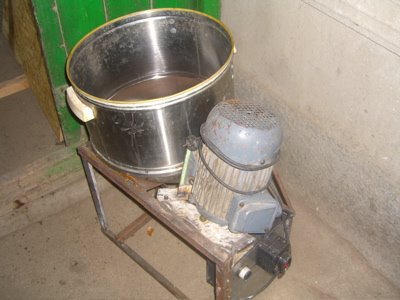
I came home today to the sound of grinding. Piles of walnuts, still in their fruity, green outer shell were being fed into a machine (actually a revamped washing machine) that scraped this layer off, leaving the hard, brown shell that most of us see and struggle to crack to reach the nut inside. My 27-year old host-brother is starting a business, and I’d say he’s off to a fantastic start.
 He owns about 10 hectares of walnut trees. Normally he can sell these green walnuts for just under 1 lei (7 cents) per kilo. After peeling off this layer they sell for anywhere from 5 to 13 times that much. So, he and some friend took apart an old washing machine, put a kind of rotating blade on the bottom, and voila – about 1000 kilos of peeled walnuts in a day. The work on the machine cost him about $150, and he’s hoping to save enough to buy a $2500 machine (which I helped him find on the Internet, thank you very much) that actually breaks the inner and harder brown shell and removes the nut, which he can sell for about 60 lei per kilo.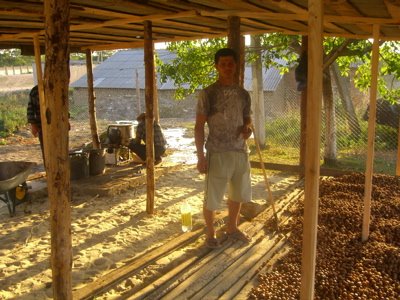
It was so refreshing to see a totally new business in the village – not just another general store. I really think he’s going to be successful.
Subscribe to:
Posts (Atom)