I've moved out of my training host-family's and will stay the night with all the other members of my group in the capital tonight. We'll be dining at a fine restaurant for our last civilized meal and then tomorrow afternoon we officially swear-in. I'll be playing a song on the guitar and singing in Russian with my host-mother. It's called "Poost," which is sort of translated loosely as "Ahhh, fuggetaboutit."
Then I leave immediately after swear-in for my new site. I'll probably be beyond the reach of the Internet superhighway over the next week while I figure out where everything is and whether I should visit the communal bit first thing in the morning or last thing at night...
But, I'll be back in the capital for a few days for a conference and a joint Thanksgiving dinner and talent show with all the PCVs. Will check email and make another post then. Ciao.
Showing posts with label Pre-Service Training (PST). Show all posts
Showing posts with label Pre-Service Training (PST). Show all posts
Wednesday, November 16, 2005

Friday, November 11, 2005
Wine Tour


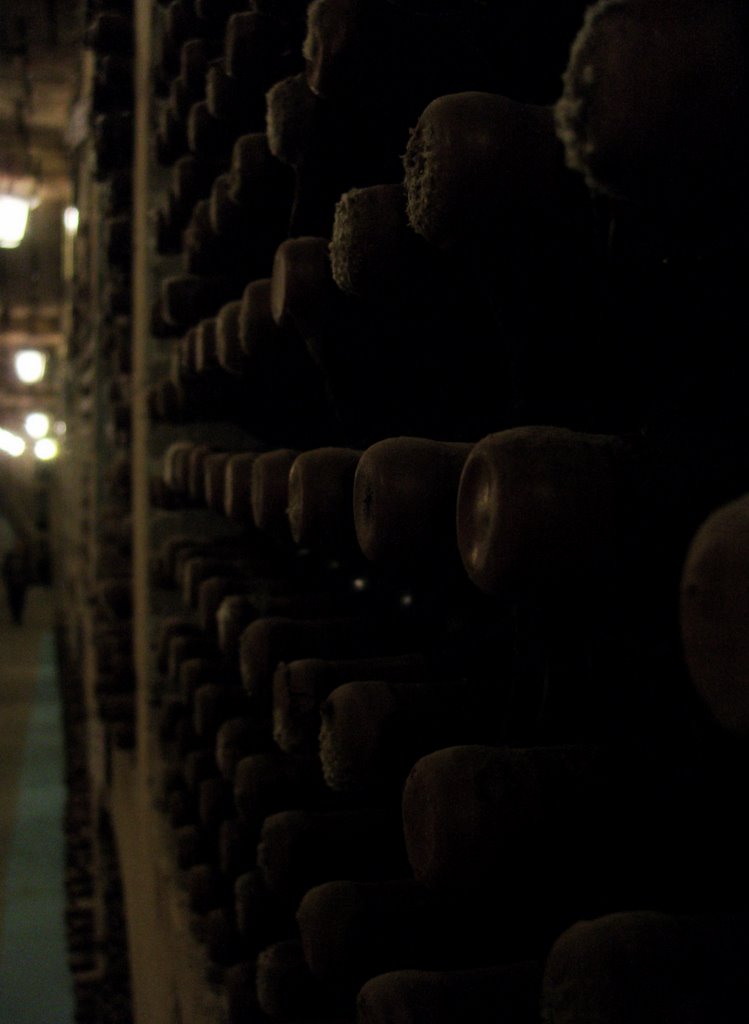

We were fortunate enough to go on a winery tour of the State Enterprise Quality Wines Industrial Complex "Milestii Mici"(or for short and in English, Milesti Meech). It claims to be, and after being there I believe it, the largest wine cellar in the world. The catacombs were formerly tunnels for a lime mine, but for the last 40 years they’ve been reclaimed to serve as the maturing place for millions of liters of wine.
The tunnels have the ideal conditions for maturing wines. Located 40-85 meters (130-280 feet) below ground, they’re (obviously) dark and maintain a year-round temperature of 12-14 degrees Centigrade (in the mid-50s) and a humidity of 85-95% (we also use percentages in America, so I’m not going to bother converting this figure). There are 50km (31 miles) of tunnels passable by car and I saw several trucks down there being operated by some of the 350 workers who work underground every day.
Interestingly, this winery doesn’t have it’s own wine. It has no vineyards that produce grapes – it old acts as a holding place for others’ wines to mature, though apparently there are plans to purchase land and being producing their own grapes soon.
Oh, a word about the pictures… In most of the tunnels I saw there are these huge barrels along the walls, most 6 feet or more in diameter. The wine is pumped into the barrels, which never move, where it ages for a certain period of time, absorbing the flavor of the wood. Then it is bottled where it continues to age. All the specifics are way beyond me, but I admit I was impressed by the operation.
Monday, November 07, 2005
BDO

I must admit that my 2nd time through training is starting to wear on me. I’m ready to have a schedule of my own design, to start my real work, and to not have to sit through sessions that I already sat through back in Uzbekistan.
In part due to this desire for independence, 5 of us trainees opted out of a PC-organized day trip to southern Moldova (where I’ll be living for 2 years anyway). Instead, we decided to have a relaxing BDO (Boyz Day Out) in the capital. After meeting at noon, we wandered about town and chose a cheap kebab stand for lunch, sat in a park, drank real coffee in a café, hit another kebab stand for dinner, and capped off the evening with a screening of “Crash” at a small English movie theater. All in all, not a bad way to spend a day…
Pictured are the boyz in the movie theater, which is approximately the size of my living room and seats about 25 people in very comfortable slightly reclining seats, complete with a small table between every two seats for whatever drink you purchased at the downstairs bar and wish to enjoy during the film.
Sunday, October 30, 2005
Gypsies in Soroca
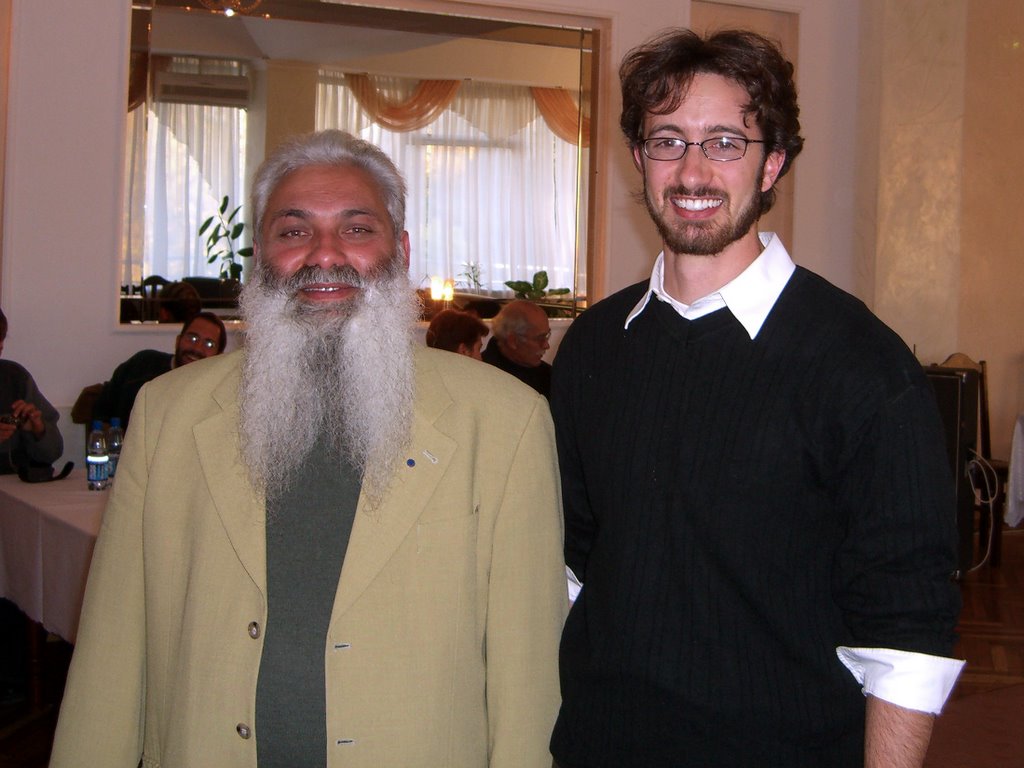


Yesterday most of my group took a trip to the northern city of Soroca, directly across the Nistru River from Ukraine. There's an ancient castle there, through which we were able to roam. Afterwards we had lunch and listened to a panel discussion led by the Gypsy Baron (see the outrageous beard).
Here in Moldova - and probably throughout the world - Gypsies (or Roma in Romanian) are frequently discriminated against and stereotyped as a wild, theiving, dirty lot. We really didn't have much time to really get to know those Gypsies we did meet, but I found them to be very friendly, though torn between their traditions and changing to adapt to the modern world.
PS - Note the sign we saw in the castle - no smoking, no bathroom, and no sunflower seeds. Only in Moldova...
One friend of mine will be working with an Gypsy organization that seeks to improve the condition of this ethnicity and I look forward to hearing how his work goes.
Wednesday, October 26, 2005
I Had a Dream...
…in Russian. I suppose this first dream in a Russian is a good sign that the language is sinking into my subconscious and that fluency is just around the corner, though the jury is still out on whether it is just the first signal of an impending mental breakdown (just a joke, Mom – I’m fine). Regardless, I can’t for the life of me figure out what the dream’s plot means. Feel free to make comments here about your interpretation – best suggestion will get a prize (honestly!)
In my dream, I’m driving a car somewhere when it breaks down. I pull over to the side of the road. Two men appear and I explain the situation to them (in Russian) and they offer to take a look at my engine to see if they can fix it, which they soon realize they cannot do.
Then I see a watch in the back seat of my car and I think, “Maybe this watch belongs to one of the dudes who just tried to help me.” Being the fine gentleman that I am and not wishing to deprive anyone of their property, I ask if it belongs to them. Though I don’t really get an answer, one of them takes it.
Next I think, “Maybe it doesn’t really belong to one of them, but they just want a free watch.” So I say, “Hey, if that watch isn’t yours you should give it back. It might belong to one of my friends.” Again, they don’t give it back or say anything, but it becomes increasingly clear that the watch does not, in fact, belong to them.
Suddenly, I’m talking to some woman about the watch because apparently her daughter now has it. I tell her the watch must belong to one of my friends, to which she replies that perhaps the watch belongs to her daughter and it fell off in my car, to which I reply that I’ve never even seen her daughter before. At this point she relents, calls her daughter over, and returns the watch.
Then I woke up. A lei for your thoughts? [A lei (pronounced “lay”) is the Moldovan currency and is equivalent to about 8 cents. So, you’re actually getting a good deal – 8 pennies instead of the usual going rate of 1 – and the additional pleasure of being part of a joke with sexual innuendo because I’m offering to give you a “lay.” Isn’t explained humor funny?]
In my dream, I’m driving a car somewhere when it breaks down. I pull over to the side of the road. Two men appear and I explain the situation to them (in Russian) and they offer to take a look at my engine to see if they can fix it, which they soon realize they cannot do.
Then I see a watch in the back seat of my car and I think, “Maybe this watch belongs to one of the dudes who just tried to help me.” Being the fine gentleman that I am and not wishing to deprive anyone of their property, I ask if it belongs to them. Though I don’t really get an answer, one of them takes it.
Next I think, “Maybe it doesn’t really belong to one of them, but they just want a free watch.” So I say, “Hey, if that watch isn’t yours you should give it back. It might belong to one of my friends.” Again, they don’t give it back or say anything, but it becomes increasingly clear that the watch does not, in fact, belong to them.
Suddenly, I’m talking to some woman about the watch because apparently her daughter now has it. I tell her the watch must belong to one of my friends, to which she replies that perhaps the watch belongs to her daughter and it fell off in my car, to which I reply that I’ve never even seen her daughter before. At this point she relents, calls her daughter over, and returns the watch.
Then I woke up. A lei for your thoughts? [A lei (pronounced “lay”) is the Moldovan currency and is equivalent to about 8 cents. So, you’re actually getting a good deal – 8 pennies instead of the usual going rate of 1 – and the additional pleasure of being part of a joke with sexual innuendo because I’m offering to give you a “lay.” Isn’t explained humor funny?]
Tuesday, October 25, 2005
Home Cooking
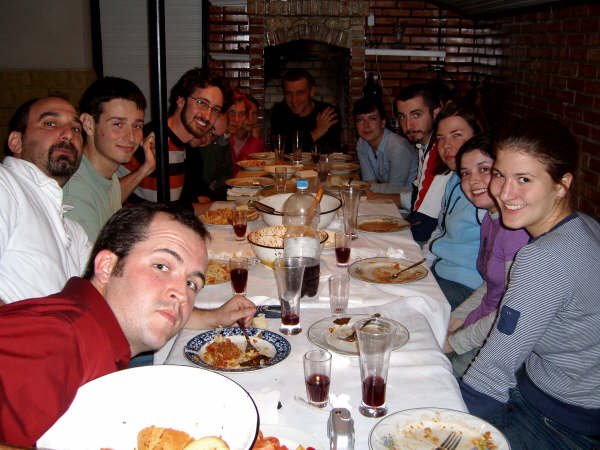

Not that the food here has been terrible, but there’s no substitute for the quality or variety of home – especially when my family does the cooking. Knowing that the best way to the heart is through the stomach, I decided to give a dinner party for my host family and 12 other PCVs. The main course was home-made-from-scratch tomato sauce and pasta, with approximately 9 liters of month-old Moldovan wine. Special thanks to all who helped make the evening a success through financial contributions, culinary expertise, or musical talent for the post-dinner sing-a-long.
Here’s the recipe if those back in the States tire of Ragu or if those abroad want an excellent meal. I’m going to write what you need to feed 16 people with the metric system. You figure out the conversions.
Ingredients:
4 kilos of tomatoes
1 kilo onions1 kilo green peppers1 kilo chopped meat (beef) – this might be hard to come by outside the capital, but you might be able to substitute lamb or pork or make it vegetarian
red wine
olive oil – or cheaper oil is OK if it’s too pricey for you here in Moldova
garlic
oregano
bay leaves
salt
pepper
sugar
pasta
Directions:
I suppose it goes without saying, clean all the veges.
Cut a small “X” in the bottom of all the tomatoes and drop them into a pot of almost-boiling water for a few minutes. The skin will start to come off. Remove the tomatoes and peel the skin off and de-stem them.
Place these skinned tomatoes in a bowl and mash them with your hands.
Sautee the onions and green peppers and crushed garlic – about 4-5 cloves.
Brown the meat and pour off the excess fat.
Combine the meat, sautéed vegetables, and tomatoes in a big pot.
Cook for a few hours until it thickens to your liking. Add salt, pepper, oregano, bay leaves, sugar, and red wine to taste.
Make the pasta and eat!
Oh yeah – garlic bread goes well with this – just sautee up some additional crushed garlic and spread it on sliced bread with olive oil and bake for 5-10 minutes.
Sunday, October 23, 2005
Connected
I got a cell phone today - thanks to departing PCVs who sold (or gave away) all their stuff at rock bottom prices. Won't post the number here, so write me if you want it. I can receive calls from the States on it and it won't use up any of my minutes. Of course, there's still the land-line option at my host family's house - number posted to the left - which will be good until I move to my permanent site in mid-November.
Saturday, October 22, 2005
Cold
The weather has changed, and it keeps on changing which is really wreaking havoc on my fashion sense… In the morning when I leave for the day it’s pretty chilly and most buildings are not much warmer than the outside. But by the middle of the day it can be downright warm, and if you’re going to be on any kind of (crowded) public transportation for any period of time longer than 10 minutes, you better strip down before getting on – God knows there won’t be room to do so once the door closes. Layering is key…
Heat comes in two forms – gas or soba. Gas, I’m sure, most of you are familiar with. It’s used to heat water which warms radiators throughout the house which in terms warms the air. Gas is centrally controlled, meaning the government picks a certain day on which it is turned on – usually sometime in mid-November – and after that people can be somewhat warm, though most buildings never really get toasty. Sobas are sort of like think chimneys usually in the center of the house that radiate heat. One side of the chimney makes up part of a wall to a few rooms. Just about anything can be burned in these sobas – usually coal, wood, de-kerneled corn husks, dried corn stalks, or some mixture thereof.
At night, my room and much of the house I’m guessing hits somewhere in the low-50s. I’ve taken to using my wonderful longjohns and sleeping bag to stay warm. Fortunately, Peace Corps issued us portable electric radiators and will reimburse us for the added electricity they consume. Thus far, I’ve been very pleased with the operation of my unit, though I have no idea how I’m going to move this heavy beast to my site when training is over.
And of course, today I'm wearing a t-shirt because it's so damn hot.
Heat comes in two forms – gas or soba. Gas, I’m sure, most of you are familiar with. It’s used to heat water which warms radiators throughout the house which in terms warms the air. Gas is centrally controlled, meaning the government picks a certain day on which it is turned on – usually sometime in mid-November – and after that people can be somewhat warm, though most buildings never really get toasty. Sobas are sort of like think chimneys usually in the center of the house that radiate heat. One side of the chimney makes up part of a wall to a few rooms. Just about anything can be burned in these sobas – usually coal, wood, de-kerneled corn husks, dried corn stalks, or some mixture thereof.
At night, my room and much of the house I’m guessing hits somewhere in the low-50s. I’ve taken to using my wonderful longjohns and sleeping bag to stay warm. Fortunately, Peace Corps issued us portable electric radiators and will reimburse us for the added electricity they consume. Thus far, I’ve been very pleased with the operation of my unit, though I have no idea how I’m going to move this heavy beast to my site when training is over.
And of course, today I'm wearing a t-shirt because it's so damn hot.
Thursday, October 20, 2005
My Site Visit
I'm back. My 3-day visit to my future work site is over, as is the 2-day conference that followed with all PCVs and their Moldovan counterparts. Here's the story…
I left my house around 2pm on Saturday to get to Chisinau's southern bus, Gard de Sud. I had already purchased my ticket that morning and felt pretty certain I knew where the bus would be. I was correct, and after a brief discussion with the "ticket-taker" at the door to the bus, I was settled. [I've since learned that this discussion was his complaint that I had already purchased my ticket from the counter inside the bus station. Apparently, sometimes you purchase the ticket directly from the bus driver – which is technically illegal and earns the driver a little extra cash – and sometimes you purchase the ticket at the ticket window. Your guess is as good as mine as to which one is proper and when.]
To say the bus is crowded would be like saying there are a few stars in the sky. The aisles are filled with extra plastic stools so more people can be squeezed on. There is no AC, only small air vents on the roof of the bus. These vents actually worked quite well until they were all shut by the locals once the bus got underway to ward off the deadly "current" (wind). Fortunately, I was prepared with several layers and so I stripped down as I tried to understand the onboard Russian-dubbed movie, Mr. and Mrs. Smith.
Along the way the country side flew by repetitively. Moldova is a land of farms, and most of the roads I was on passed black fields of rich soil. Tiring of reading and straining to understand Brad Pitt's Russian voiceover, I struck up a conversation with my neighbors, thereby announcing that I was, in fact, an American – as if my beard, longer hair, backpack, and clothes didn't already scream "I'm not from here!" This decision of mine (to converse with my neighbors) would come to play an important role when I disembarked in Copceac (pronounced Kop-chack) 3 hours later.
As we pulled into town, my southbound bus was flanked on the right by a beautiful setting sun and on the left by a rising full moon. All seemed right to me. I thought, "This is where I'm supposed to be."
And then I got off the bus and found no one to meet me.
Fortunately, one of my new bus friends, Valeri, was neighbor to the mayor, my counterpart, and walked me to his house, where no one was to be found. So, we went to Valeri's house where I met his wife and daughter, who went next door to get a phonebook so we could call the mayor's house to see if anyone was inside. We called and confirmed no one was there. So then I think I should go back to the bus station – which is really just where the bus dropped me off, not really a station at all. We do and again, no one is there. I thought I'd use the phone nearby in the main store to call Peace Corps, but that phone like the one at Valeri's house can only call within the village. So then I start calling the phone numbers I have for the families I'm supposed to meet on this trip to pick one with whom to live. Fortunately, one was home and came to pick me up at the store. From their house, I could call PC, who then called my counterpart on his cell, who then called me at the house to apologize. Apparently, he had asked someone to meet me because he had to shuck corn on his mother's farm and my bus had come in early, so that's why no one was there. Anyway, no harm done and it made for an adventure.
I've decided to live in an apartment with a single 50ish-year old teacher. Though the smallest of all the places and the only apartment I saw, it was clean and the woman, Valentina, seemed very interested in learning about America and was open to a new culture and sharing her own. She has two older sons who don't live there but occasionally visit. I met one and he seems very nice.
Sunday I spent with my counterpart, Oleg, and his friends visiting different families and watching several football (soccer) matches in a pretty great 2-year old stadium in the village, and drinking plenty of vodka. As I mentioned in an earlier post, Gagauzia is a semi-autonomous region of Moldova. The first language in my village is Gagauz, a Turkish dialect, followed by Russian. Very few speak Romanian, the official language of Moldova. Maybe after a year of Russian I'll start working on Gagauz…
Monday I met everyone in the office, cleaned my desk, and read a lot of my Russian dictionary and "Atlas Shrugged" while doing very little at my desk, which is in a separate room from everyone and everything else. Boring quickly of that, I went into Oleg's office where it seems he sees people all day long who come to him with their problems and he makes some phone calls to fix them. I also hung out with the 5 accountants who use huge pieces of paper, calculators, and white-out to keep track of the village's finances. I see an MSExcel training in their future…
All in all, it was a good trip. I like my counterpart a lot – he's smart, funny, and seems genuinely willing to work with me. I think I'll have a lot of freedom to do what I want – sort of a big fish in a small pond – and after a few months at site improves my language and I figure out what are the needs of the village and my office, I look forward to starting my work in earnest. For now, one more month of training…
I left my house around 2pm on Saturday to get to Chisinau's southern bus, Gard de Sud. I had already purchased my ticket that morning and felt pretty certain I knew where the bus would be. I was correct, and after a brief discussion with the "ticket-taker" at the door to the bus, I was settled. [I've since learned that this discussion was his complaint that I had already purchased my ticket from the counter inside the bus station. Apparently, sometimes you purchase the ticket directly from the bus driver – which is technically illegal and earns the driver a little extra cash – and sometimes you purchase the ticket at the ticket window. Your guess is as good as mine as to which one is proper and when.]
To say the bus is crowded would be like saying there are a few stars in the sky. The aisles are filled with extra plastic stools so more people can be squeezed on. There is no AC, only small air vents on the roof of the bus. These vents actually worked quite well until they were all shut by the locals once the bus got underway to ward off the deadly "current" (wind). Fortunately, I was prepared with several layers and so I stripped down as I tried to understand the onboard Russian-dubbed movie, Mr. and Mrs. Smith.
Along the way the country side flew by repetitively. Moldova is a land of farms, and most of the roads I was on passed black fields of rich soil. Tiring of reading and straining to understand Brad Pitt's Russian voiceover, I struck up a conversation with my neighbors, thereby announcing that I was, in fact, an American – as if my beard, longer hair, backpack, and clothes didn't already scream "I'm not from here!" This decision of mine (to converse with my neighbors) would come to play an important role when I disembarked in Copceac (pronounced Kop-chack) 3 hours later.
As we pulled into town, my southbound bus was flanked on the right by a beautiful setting sun and on the left by a rising full moon. All seemed right to me. I thought, "This is where I'm supposed to be."
And then I got off the bus and found no one to meet me.
Fortunately, one of my new bus friends, Valeri, was neighbor to the mayor, my counterpart, and walked me to his house, where no one was to be found. So, we went to Valeri's house where I met his wife and daughter, who went next door to get a phonebook so we could call the mayor's house to see if anyone was inside. We called and confirmed no one was there. So then I think I should go back to the bus station – which is really just where the bus dropped me off, not really a station at all. We do and again, no one is there. I thought I'd use the phone nearby in the main store to call Peace Corps, but that phone like the one at Valeri's house can only call within the village. So then I start calling the phone numbers I have for the families I'm supposed to meet on this trip to pick one with whom to live. Fortunately, one was home and came to pick me up at the store. From their house, I could call PC, who then called my counterpart on his cell, who then called me at the house to apologize. Apparently, he had asked someone to meet me because he had to shuck corn on his mother's farm and my bus had come in early, so that's why no one was there. Anyway, no harm done and it made for an adventure.
I've decided to live in an apartment with a single 50ish-year old teacher. Though the smallest of all the places and the only apartment I saw, it was clean and the woman, Valentina, seemed very interested in learning about America and was open to a new culture and sharing her own. She has two older sons who don't live there but occasionally visit. I met one and he seems very nice.
Sunday I spent with my counterpart, Oleg, and his friends visiting different families and watching several football (soccer) matches in a pretty great 2-year old stadium in the village, and drinking plenty of vodka. As I mentioned in an earlier post, Gagauzia is a semi-autonomous region of Moldova. The first language in my village is Gagauz, a Turkish dialect, followed by Russian. Very few speak Romanian, the official language of Moldova. Maybe after a year of Russian I'll start working on Gagauz…
Monday I met everyone in the office, cleaned my desk, and read a lot of my Russian dictionary and "Atlas Shrugged" while doing very little at my desk, which is in a separate room from everyone and everything else. Boring quickly of that, I went into Oleg's office where it seems he sees people all day long who come to him with their problems and he makes some phone calls to fix them. I also hung out with the 5 accountants who use huge pieces of paper, calculators, and white-out to keep track of the village's finances. I see an MSExcel training in their future…
All in all, it was a good trip. I like my counterpart a lot – he's smart, funny, and seems genuinely willing to work with me. I think I'll have a lot of freedom to do what I want – sort of a big fish in a small pond – and after a few months at site improves my language and I figure out what are the needs of the village and my office, I look forward to starting my work in earnest. For now, one more month of training…
Friday, October 14, 2005
Handicrafts
After learning our sites, we took off for a tour of local tradespersons’ homes and workshops. First stop, the spryest 83-year old man I have ever and probably will ever meet. He fought for two years in WWII and then spent 6 years after the war in a Russian POW camp. Now he has four children, the last of whom he fathered when he was 51 years old. He’s a blacksmith and an engineer and showed us all these formerly hand-powered machines that he rigged for electric power. One de-kernels cornhusks and another grinds the kernels into flower. He also pounds away on an anvil over hot coals making all manner of things.
Next stop was a local artist’s home. I think at the end of my 2 years I’ll go back and buy one of his paintings. He was very good and has a style similar to that of my own Mother (see the links to the right for her website).
Next was a local honey producer where I happily tried out his various honeys before purchasing a kilo for about $3. So good in my daily tea…
Last stop I didn’t really understand, but I think it was a family known for their needlework. After touring their home they treated us to Moldovan songs and dance, and to return the favor we sang “When the Saints Go Marching In” and did the Hokey Pokey. I think we got the better end of the bargain.
Next stop was a local artist’s home. I think at the end of my 2 years I’ll go back and buy one of his paintings. He was very good and has a style similar to that of my own Mother (see the links to the right for her website).
Next was a local honey producer where I happily tried out his various honeys before purchasing a kilo for about $3. So good in my daily tea…
Last stop I didn’t really understand, but I think it was a family known for their needlework. After touring their home they treated us to Moldovan songs and dance, and to return the favor we sang “When the Saints Go Marching In” and did the Hokey Pokey. I think we got the better end of the bargain.
Thursday, October 13, 2005
My Site
Well, it’s official – at the end of training I’ll be working in a mayor’s office in a village of about 10,000 people at the southern tip of Moldova. I found out on Wednesday and on Saturday I’ll be headed there alone for 3 days to meet my counterpart (the mayor) and my new host family. I’m really looking forward to it and will let you all know how the trip turned out towards the end of next week.
Our placement ceremony was uniquely presented. A large map of the country was drawn on the floor of a gymnasium and chairs were placed at each site throughout the country with the names of cities, towns, or villages on them. As PCVs’ names were pulled out of a hat, their sites were announced and each of us went to sit in our chair. By the end of the ceremony, you could look around and see who was near and who was far away – though in such a small country no one is really that far away.
The process by which PCVs’ sites are determined is different than it was in Uzbekistan. There, PCVs had several interviews with staff members in which they answered questions about their preferences – rural vs. urban, east vs. west, proximity to other PCVs, desire to work on a particular issue, etc. Then, toward the end of training each PCV was handed a manila envelope and on the count of 3 we all tore open our packages and found where we were headed for 2 years.
Not so in Moldova. Here, we are given the applications that organizations filled out to get a PCV and have about a week to review them. [Of course, we’re only given the applications that Peace Corps approved. I don’t know how many organizations apply for a Volunteer or how many are approved or rejected, but there must be some that get turned down. Or at least I hope there are.] Then we rank our top-3 and turn in our choices. PC staff tries to accommodate our preferences, but ultimately the decision rests with them.
Our placement ceremony was uniquely presented. A large map of the country was drawn on the floor of a gymnasium and chairs were placed at each site throughout the country with the names of cities, towns, or villages on them. As PCVs’ names were pulled out of a hat, their sites were announced and each of us went to sit in our chair. By the end of the ceremony, you could look around and see who was near and who was far away – though in such a small country no one is really that far away.
The process by which PCVs’ sites are determined is different than it was in Uzbekistan. There, PCVs had several interviews with staff members in which they answered questions about their preferences – rural vs. urban, east vs. west, proximity to other PCVs, desire to work on a particular issue, etc. Then, toward the end of training each PCV was handed a manila envelope and on the count of 3 we all tore open our packages and found where we were headed for 2 years.
Not so in Moldova. Here, we are given the applications that organizations filled out to get a PCV and have about a week to review them. [Of course, we’re only given the applications that Peace Corps approved. I don’t know how many organizations apply for a Volunteer or how many are approved or rejected, but there must be some that get turned down. Or at least I hope there are.] Then we rank our top-3 and turn in our choices. PC staff tries to accommodate our preferences, but ultimately the decision rests with them.
Monday, October 10, 2005
'Tis the Season

The season for making wine, that is… Though Moldova occupies 0.2% of the former Soviet Union’s land area, at one point it produced 13% of the USSR’s wine. To say Moldovan’s love their wine would be a gross understatement. Virtually every house here has a sizable garden and most of those include grapevines. Last week seemed to be the harvest time when the grapes were picked and crushed to being making the vino. Sadly, I was busy on the weekend and couldn’t help out (but there’s always next year… and the year after that!) I did, however, get some pictures and thought you might be interested in how wine is made the old fashioned way.
First you pick the grapes and drop them in a big bowl (pictured below). Then you squash the grapes and basically let it sit for a few days. Apparently the skin of the grape is what gives the wine its flavor, so you want the juice to marinate in the skins for a little while. Then you transfer the wine to a large holding tank that most families seem to have in their basements where you add sugar to taste. Then let it sit, or bottle it in old plastic bottles and drink over the rest of the year. Pretty simple, really.
To celebrate the occasion, there were festivals everywhere. I went into the capital city, Chisinau on Saturday to soak in the occasion. On Sunday my hometown, Ialoveni, had its own festival at which I was asked to perform what has become my pay-dirt song, “Hotel California,” and then play some blues with my harmonica-playing fellow PCV, Adam. As you can see we both got flowers, which (I’m pretty sure) means they liked our music.
Wednesday, October 05, 2005
A Capital Trip
October 05
Last Saturday we were turned loose in the capital, Chisinau (pronounced Key-shin-now in Romanian or Key-shin-nyov in Russian). It's an interesting place. In general, it's wealthier than Uzbekistan, but still has a wide range between the poor or middle class who shop in the open-air markets and bazaars and the rich who eat at McDonald's (there are 3 of them in the capital and it's actually a sign of high status to be able to eat at one) or shop in the rich stores - I poked my head into a Hugo Boss and Puma store where a pair of sneakers cost the equivalent of $100 - the same amount my host father makes in a month.
After picking up some hangers, oranges, and a beard-trimmer to replace the one I brought from America and somehow fried on the voltage over here, we visited the PC Office and then hit a Middle-Eastern restaurant named, "Class" for a fantastic lunch. I have hummos, tabouli, and shish taouk and can't wait to go back there! Just like being at King of Shish Kebab back in Jersey...
We also saw the US Embassy, which I cannot go into despite my American citizenship, unless I have an appointment or its an emergency; one movie theater that shows films in Russian and another that shows them in English; a place that can develop digital photos; and in general figured out the layout of the city.
Last Saturday we were turned loose in the capital, Chisinau (pronounced Key-shin-now in Romanian or Key-shin-nyov in Russian). It's an interesting place. In general, it's wealthier than Uzbekistan, but still has a wide range between the poor or middle class who shop in the open-air markets and bazaars and the rich who eat at McDonald's (there are 3 of them in the capital and it's actually a sign of high status to be able to eat at one) or shop in the rich stores - I poked my head into a Hugo Boss and Puma store where a pair of sneakers cost the equivalent of $100 - the same amount my host father makes in a month.
After picking up some hangers, oranges, and a beard-trimmer to replace the one I brought from America and somehow fried on the voltage over here, we visited the PC Office and then hit a Middle-Eastern restaurant named, "Class" for a fantastic lunch. I have hummos, tabouli, and shish taouk and can't wait to go back there! Just like being at King of Shish Kebab back in Jersey...
We also saw the US Embassy, which I cannot go into despite my American citizenship, unless I have an appointment or its an emergency; one movie theater that shows films in Russian and another that shows them in English; a place that can develop digital photos; and in general figured out the layout of the city.
Sunday, October 02, 2005
Necks
My host mother makes a decent chicken soup, and there are these U-shaped pieces of meat that are very boney. Turns out they're chicken necks. The meat is good, but you really have to pick it off with your fingers - it's a little gross to try to chew it off because all these little vertebrae keep getting in the way of my teeth.
Friday, September 30, 2005
More Background...
Today a couple folks from the US Embassy led an excellent session on the recent political history of Moldova. Here’s what I learned…
What is now known as Moldova has at one time or another been a part of various empires. Within the last century, it has gone back and forth between Romania and the former Soviet Union and it is still pulled in both directions as well as toward embracing its new independence. A couple important dates:
1812 – Moldova (called Bessarabia) becomes part of Russia
1917 – The Bolsheviks take control in Russia and agree to withdraw from Moldova to appease Germany
1920 – Moldova becomes part of Romania again, as it was before 1812
[Russia and Romania do not maintain diplomatic relations during WWI over dispute about ownership of Moldova/Bessarabia
post-WWII: Romania takes over Moldova and Transylvania, doubling its size
1924 – The USSR creates the Moldovan Autonomous Soveit Socialist Republic (MASSR) comprised of parts of current western Ukraine and current Transinistria (a currently disputed territory on the east coast of Moldova – see more on Transinistria below). The MASSR is essentially set up to allow the USSR to continue to lay claim to the rest of Moldova/Bessarabia, which is still controlled by Romania. The MASSR claims the city of Chisinau as its capital even though it lies within the borders of the Romanian controlled Moldova.
1941 – The Romanians attack as part of the Axis powers during WWII. They take much land in the MASSR and Ukraine
post-WWII: The USSR reclaims all lost territory. Current boundary of Moldova and Ukraine is set, with Transinistria as part of Moldova
1991 – USSR collapses and Moldova becomes an independent nation.
When Moldova declared its independence, two parts of the new country also declared their own independence – Gaguzia in the south and Transinistria in the east. These two areas were concerned that the newly independent nation of Moldova might wish to rejoin Romania, which they did not wish to do being more aligned with the former-USSR and Russia. In 1992 a civil war broke out between Transinistria and Moldova in which 300 people were killed before a cease-fire was negotiated. In 1994 Moldova officially adopted its Constitution and Gaguzia agreed to accept a special status as a semi-independent part of Moldova; Transinistria does not accept the same deal.
Transinistria still remains in a sort-of limbo. This tiny sliver of land between Moldova and Ukraine claims independence, but is not recognized by any other nation. It has its own currency and Russian troops act as peace keepers. It’s sort of like an open sore on Moldovan’s border and I do not think the nation can move far forward – and it certainly cannot gain entry into the European Union – until this issue is resolved.
What is now known as Moldova has at one time or another been a part of various empires. Within the last century, it has gone back and forth between Romania and the former Soviet Union and it is still pulled in both directions as well as toward embracing its new independence. A couple important dates:
1812 – Moldova (called Bessarabia) becomes part of Russia
1917 – The Bolsheviks take control in Russia and agree to withdraw from Moldova to appease Germany
1920 – Moldova becomes part of Romania again, as it was before 1812
[Russia and Romania do not maintain diplomatic relations during WWI over dispute about ownership of Moldova/Bessarabia
post-WWII: Romania takes over Moldova and Transylvania, doubling its size
1924 – The USSR creates the Moldovan Autonomous Soveit Socialist Republic (MASSR) comprised of parts of current western Ukraine and current Transinistria (a currently disputed territory on the east coast of Moldova – see more on Transinistria below). The MASSR is essentially set up to allow the USSR to continue to lay claim to the rest of Moldova/Bessarabia, which is still controlled by Romania. The MASSR claims the city of Chisinau as its capital even though it lies within the borders of the Romanian controlled Moldova.
1941 – The Romanians attack as part of the Axis powers during WWII. They take much land in the MASSR and Ukraine
post-WWII: The USSR reclaims all lost territory. Current boundary of Moldova and Ukraine is set, with Transinistria as part of Moldova
1991 – USSR collapses and Moldova becomes an independent nation.
When Moldova declared its independence, two parts of the new country also declared their own independence – Gaguzia in the south and Transinistria in the east. These two areas were concerned that the newly independent nation of Moldova might wish to rejoin Romania, which they did not wish to do being more aligned with the former-USSR and Russia. In 1992 a civil war broke out between Transinistria and Moldova in which 300 people were killed before a cease-fire was negotiated. In 1994 Moldova officially adopted its Constitution and Gaguzia agreed to accept a special status as a semi-independent part of Moldova; Transinistria does not accept the same deal.
Transinistria still remains in a sort-of limbo. This tiny sliver of land between Moldova and Ukraine claims independence, but is not recognized by any other nation. It has its own currency and Russian troops act as peace keepers. It’s sort of like an open sore on Moldovan’s border and I do not think the nation can move far forward – and it certainly cannot gain entry into the European Union – until this issue is resolved.
Wednesday, September 28, 2005
The Routine
Life has settled into something of a routine. – up everyday at 6:45, eat breakfast and walk 30 minutes to language class (or occasionally take a marshutka, but that somehow feels like cheating when the weather is nice), 4 hours of language, then lunch, and then spend the rest of the day either studying language or doing some other kind of work. I recently found a gym at which I can work out 3 times a week – plus 75 cents for each additional visit – for about $7 per month. There’s also a somewhat daily basketball game on a pretty terrible court behind a local school. Some of the Moldovans are pretty good, but they haven’t really mastered the pick yet, which I’ve been using to my advantage. Evenings are for dinner with the fam, shower, homework, reading, practicing the guitar (if I have the time), or entertaining guests and neighbors who stop by. I usually hit the sack pretty worn out by 10:30, but have yet to sleep through the night on account of the neighbors’ dogs who think it important to bark at everything between the hours of 4 and 6am.
One non-language assignment that has been taking up my time is to essentially explore your town and report back on what you found. My friend Adam and I have taken some artistic liberty and are making very hard-hitting a “mockumentry.” Highlights thus far include an interview with the 9-year old leader of a deadly gang of ruffians that rule the streets and my attempt to interview a dentist while he performs a root canal. [What can I say? I knocked on the door and he told me to come in!]
Two days a week all the PCTrainees come into my town from neighboring villages for our “Hub Days.” These include sessions from PCAdmin on everything from preventing diarrhea to opening a bank account. On our last Hub Day, we gave feedback on the training thus far. I give the staff a lot of credit for opening themselves up to constructive criticism, but that’s the best way to get better. Overall, we all thought PC was doing a bang-up job. Their organization and language teachers received very high marks and hopefully our suggestions for additional language classes and time to get to know the PCTs in villages besides our own will be implemented.
One non-language assignment that has been taking up my time is to essentially explore your town and report back on what you found. My friend Adam and I have taken some artistic liberty and are making very hard-hitting a “mockumentry.” Highlights thus far include an interview with the 9-year old leader of a deadly gang of ruffians that rule the streets and my attempt to interview a dentist while he performs a root canal. [What can I say? I knocked on the door and he told me to come in!]
Two days a week all the PCTrainees come into my town from neighboring villages for our “Hub Days.” These include sessions from PCAdmin on everything from preventing diarrhea to opening a bank account. On our last Hub Day, we gave feedback on the training thus far. I give the staff a lot of credit for opening themselves up to constructive criticism, but that’s the best way to get better. Overall, we all thought PC was doing a bang-up job. Their organization and language teachers received very high marks and hopefully our suggestions for additional language classes and time to get to know the PCTs in villages besides our own will be implemented.
Sunday, September 25, 2005
Background
Last Thursday part of my training included an excellent presentation by an employee of the Urban Institute. He is a former PCV himself, and later served as a PC Country Director in three nations. Anyway, it was one of the best non-language trainings I’ve received.
The part that most interested me concerned the Moldovan economy and how it can move forward, or at the very least out of its current position as the poorest nation in Europe. Currently 6-900,000 citizens of Moldova work outside the country. Considering that the national population is only slightly more than 4 million, a considerable percentage of the workforce is employed outside the national economy. Essentially, there are no jobs to be found here – or at least not high paying ones – so Moldovans go abroad to get them.
Case-in-point, my host father earns about $100 per month working at a phone company, and my mother makes $40 per month as a music teacher at a school. Currently, my host father is on “vacation” from his phone job because there happens to be a construction job available right now that pays better. When the construction job is over, so will be his vacation and he’ll return to the lower-paying telecom employment. A few years ago, he spent a year in Portugal working construction and both of his parents are there now also employed in construction.
The money earned overseas finds its way back (legally or illegally) to Moldova - $1 billion in 2004 alone – usually to support family living here. If this money were invested it might help pull the nation out of its downward economic spiral, but most of it is spent on food and other necessities of life, and not infrequently on large houses. This last commodity is often viewed as a sound investment, for the government has not (yet) taken peoples’ homes, whereas investments in businesses are subject to the expenses of corruption, arcane tax laws, and sometimes the whims of local and national officials.
[Incidentally, in a couple years (I think) Romania will become part of the EU and because Moldova and Romania used to have overlapping borders, some Moldovans are entitled to Romanian as well as Moldovan passports. Should Romania become part of the EU, Moldovans with Romanian passports will be able to travel and work freely in virtually any European nation, as opposed to the current necessity of securing work visas from host countries (if the work is going to be done legally). This is both good and bad. Good because some Moldovans will be able to secure better jobs more easily and potentially send more money home; bad because more Moldovans may flee their homeland, perhaps permanently.]
One suggested reform by the Urban Institute is for the government to make it more attractive for locals to invest locally in things that will provide ongoing sources of revenue, i.e. small businesses. This doesn’t necessarily mean that the government should create large business parks or tax breaks, but at least a fair shot at making a profit. In a sense, “If you build it, they will come.” In American, 65% of local taxes are spent locally, for which citizens receive police and fire protection, decent roads, schools, and hospitals. In Moldova, 5% of local taxes are spent locally. Meaning, there is a very top-heavy government system in this former Soviet republic and little chance for even the best local officials to drastically change things for the better.
The part that most interested me concerned the Moldovan economy and how it can move forward, or at the very least out of its current position as the poorest nation in Europe. Currently 6-900,000 citizens of Moldova work outside the country. Considering that the national population is only slightly more than 4 million, a considerable percentage of the workforce is employed outside the national economy. Essentially, there are no jobs to be found here – or at least not high paying ones – so Moldovans go abroad to get them.
Case-in-point, my host father earns about $100 per month working at a phone company, and my mother makes $40 per month as a music teacher at a school. Currently, my host father is on “vacation” from his phone job because there happens to be a construction job available right now that pays better. When the construction job is over, so will be his vacation and he’ll return to the lower-paying telecom employment. A few years ago, he spent a year in Portugal working construction and both of his parents are there now also employed in construction.
The money earned overseas finds its way back (legally or illegally) to Moldova - $1 billion in 2004 alone – usually to support family living here. If this money were invested it might help pull the nation out of its downward economic spiral, but most of it is spent on food and other necessities of life, and not infrequently on large houses. This last commodity is often viewed as a sound investment, for the government has not (yet) taken peoples’ homes, whereas investments in businesses are subject to the expenses of corruption, arcane tax laws, and sometimes the whims of local and national officials.
[Incidentally, in a couple years (I think) Romania will become part of the EU and because Moldova and Romania used to have overlapping borders, some Moldovans are entitled to Romanian as well as Moldovan passports. Should Romania become part of the EU, Moldovans with Romanian passports will be able to travel and work freely in virtually any European nation, as opposed to the current necessity of securing work visas from host countries (if the work is going to be done legally). This is both good and bad. Good because some Moldovans will be able to secure better jobs more easily and potentially send more money home; bad because more Moldovans may flee their homeland, perhaps permanently.]
One suggested reform by the Urban Institute is for the government to make it more attractive for locals to invest locally in things that will provide ongoing sources of revenue, i.e. small businesses. This doesn’t necessarily mean that the government should create large business parks or tax breaks, but at least a fair shot at making a profit. In a sense, “If you build it, they will come.” In American, 65% of local taxes are spent locally, for which citizens receive police and fire protection, decent roads, schools, and hospitals. In Moldova, 5% of local taxes are spent locally. Meaning, there is a very top-heavy government system in this former Soviet republic and little chance for even the best local officials to drastically change things for the better.
Tuesday, September 20, 2005
Internet
Posting pictures to this blog is becoming difficult because Microsoft, which hosts this blog on MSN Spaces, requires you to download some sort of program in order to post a picture. But, many internet cafes don't allow you to download anything for fear of contracting a virus. And my Apple computer can't work with Microsoft software even if I could hook it up at an internet cafe (which I can't). All of which is an excuse to say - as my brother recently put in an eloquent email to me, "Have pics, will post, trying. So don't ask."
Monday, September 19, 2005
Rockstars
Turns out this M-17 group is quite musical. There are at least 5 people who know how to play the guitar, 2 harmonica players, and one pianist. [We’re thinking, only somewhat jokingly, of forming a band.] Anyway, at the welcoming party for the 6 PCVs in my town after a round of Moldovan songs and dance, we were asked to perform. Sadly, I must admit that our first foray into expressing our American heritage through the arts was none other than the Electric Slide performed to some live Moldovan accordion and drum music played by an 10- and 12-year old boy, respectively. Next we fetched my guitar and rallied with sing-a-longs to Home on the Range, She Was Just 17, some Russian song that another PCV knew, some blues and harmonica duets, Hotel California, and closed with Yesterday.
I returned home with my family and fellow PCV Adam for a long dinner and discussion, followed by more blues performances for neighbors who stopped by.
Tomorrow starts work in earnest with my first full week of language classes. Looking forward to settling into a schedule and giving up some of my newly found groupies for some quality time with my Russian/English dictionary…
I returned home with my family and fellow PCV Adam for a long dinner and discussion, followed by more blues performances for neighbors who stopped by.
Tomorrow starts work in earnest with my first full week of language classes. Looking forward to settling into a schedule and giving up some of my newly found groupies for some quality time with my Russian/English dictionary…
Sunday, September 18, 2005
Settled

I’ve moved in with my new host family, where I’ll live for the next 3 months of training. I’m living in a regional capital about 30 minutes outside Chisinau, the capital of Moldova, but for all intents and purposes it’s a tiny village surrounded by farmland.
My host family – Vadim, Oxsana, and their 9-year old daughter Katrina – is wonderful. I’m their second PCV, but the first to have my Russian skills at a conversational level right off the bat. My first dinner went a lot more smoothly than the charades game I played for my first month in Uzbekistan and I think things will only get better from here. Vadim built this house himself, and I must admit I’m happy to see he included a hot bath and indoor toilet… There’s also a small sitting area where we eat outside when the weather is nice, though it seems I’ve brought the cold with me. After our first day in the 70s, the weather has turned cool and I usually wear a sweater. Oxsana is a music teacher who was pleased to see I brought my guitar and knew the piano – I’m hoping she’ll teach me some Russian songs.
A total of 6 of the 38 new volunteers are learning Russian, and all save one have previous experience with the language. As a result, we’re able to start at a much higher level and I think between 4 hours of language most days and living with a (talkative) Russian family, I should progress fairly quickly. Perhaps I’ll try my hand at Romanian after a year or so. Unlike Russian and similar to English, Romanian is derived from Latin and thus shares many similar words and in general is an easier language to learn.
Moldova is a lush farming nation. One difference between here and UZ I noticed immediately as we were flying in is the lack of lights at night. So much of the country is farmland that you don’t see headlights or streetlights or even lights coming from houses or apartments. Even the capital city seemed dark by comparison to Uzbekistan.
Quick story about the soil: When God made the earth, he was handing out pieces of land to the different peoples. Everyone wanted the best land and it was given out first. Gradually, the less fertile land was distributed until every part of the earth was given out. Then the Moldovans came (late), so God decided to give them a piece of heaven instead.
Sleep still comes in fits and starts. I’ve yet to adjust completely to the new time zone – I keep resisting the desire to take long naps around 10am and have yet to sleep through the night – I’m actually writing this entry after tossing and turning for a good couple of hours.
Subscribe to:
Posts (Atom)